
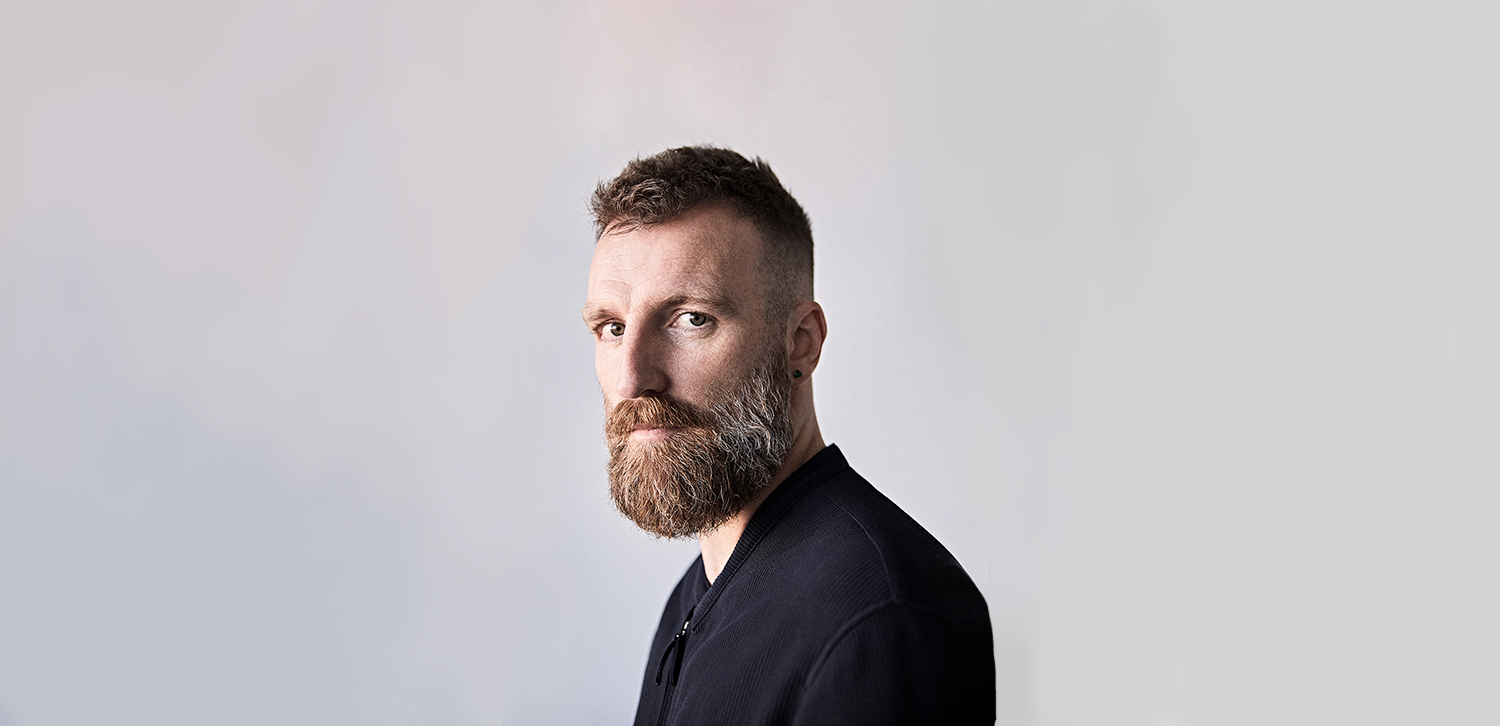
ARTIST SPOTLIGHT ON BEN FROST
Confronting the Past, Composing the Present
Written By: Prinitha Govender | Creative Director at Skripture
There’s a certain electricity that follows artist, Ben Frost, wherever he goes – a charged silence, a sense that something might detonate at any moment. The Australian-born, Iceland-based composer has long occupied that volatile space where sound becomes something much more than music: it’s a force, a weapon, a living organism. His work doesn’t so much invite you to listen as it insists that you feel it – viscerally, physically and undeniably.
This November, Frost has returned to Australian shores for the Fremantle Biennale with A Predatory Chord, a towering sound installation that continues his decades-long interrogation of power, pressure and the raw materiality of listening. In a year when the Biennale’s theme is sanctuary, Frost’s contribution feels like a provocation – what happens when sanctuary is not soft, but shuddering? When safety hums with danger? Let’s explore.
When I briefly met Frost four months ago, he struck me as quietly withdrawn, a figure folding into himself rather than stepping forward and slightly reclusive. So, when I caught up with him once again last week over coffee, ahead of Fremantle Biennale’s SANCTUARY 25 opening, I was genuinely taken aback. A short escape to Fremantle, Australia had clearly done something to him: his hair had grown into loose curls, his smile was bright, glowing skin, his demeanour was warm and mellow and the energy around him felt transformed. It was as if I were meeting an entirely different person altogether – one ready to talk, to laugh and to share the stories that shape his art and his life for that matter. Was it the salty air, the sound of seagulls, street music or the slow rhythm of the harbour? Perhaps it was all of the above.“I feel good being here,” he tells me. “I’ve commented to myself several times on several occasions since being here that I feel good here. I could live here for sure.” Frost’s heritage lies between Scottish, Swedish and there’s some Indigenous Australian from his mother’s side of the family.
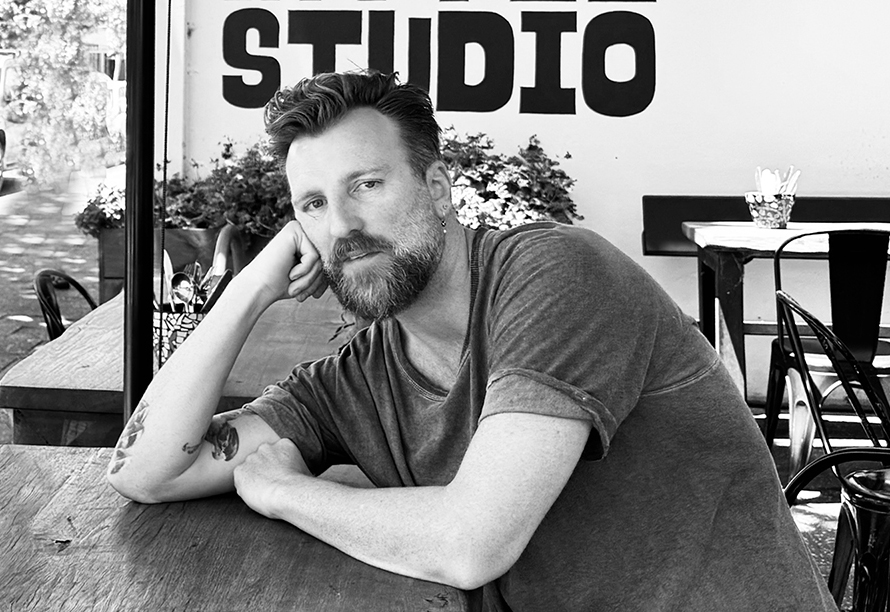
Frost explains one of the realties of life in his current city, Reykjavic, Iceland to me. “The weather there is kind of harsh and prevents a lot of time outdoors which I realised I do miss. You know, when I come back here and realise I don’t have to wear shoes anymore.” Ah yes, it looks like our barefoot-friendly town has rubbed off on him. “The simple fact is, the longer I’ve spent away from Australia, the more obvious it’s become to me just how deeply engrained this place is in me, specifically the sound, the smell, like all these things that you really can’t put your finger on,” he says. “This is nowhere to be found in Northern Europe – the way the stars are here, the sunsets here.”
I guess there’s just no place like home – a fitting discussion worth having, given Frost is here in Fremantle presenting his highly acclaimed artwork, A Predatory Chord, to Australian audiences at the year’s sanctuary-themed Fremantle Biennale. And this is precisely what I’m here to explore – the artist behind the work and some of the inspirations behind the work itself.
Frost’s composition, A Predatory Chord, feels less like a piece of music and more like an organism – it stalks its listener with low-frequency growls and sudden, serrated bursts of sound, yet within that tension I found an unexpected sense of refuge. For me, Frost builds a world where sanctuary isn’t softness but awareness: a sharpened alertness that becomes its own form of safety. In his hands, the predatory becomes protective and the sound’s relentless edge carves out a space where one can finally surrender – held, paradoxically, by the very forces that threaten to overwhelm. Surrender to that which is larger than ourselves.
Frost acknowledges his enduring obsession with the natural world and the role it plays in shaping his art. “I have a deep fascination with things like animals and plants and with uncontrolled elements like the natural ocean, things that feel bigger than me. I’ve always been drawn to those kinds of forces and so I think the process of my music becoming something more physical, more immersive, has progressed more. I’m bringing more elements into the work that are outside my control.”
Featuring speakers suspended in air, enveloped in darkness and an ethereal haze, flashes of light slivers are underlined by an overwhelming sound piece. In A Predatory Chord, Frost reimagines the PA system, a device that is often forgotten in the background, as a sculptural, intelligent instrument, bringing it into focus. He blurs the line between music and architecture, turning sound into a living, tangible and reactive ecology. Staged at Fremantle’s Victoria Hall, a striking heritage building designed by Talbot Hobbs in 1897, the work assumes a deeper, almost ritualistic power. The hall’s uninsulated, cavernous interior accentuates every swell and pause and its storied past, from parish gatherings to dance halls and community theatre, amplifies the installation’s emotional tension. “Wood carries an energy,” Frost explains, “and part of that energy comes from the memory that wood carries.” In this intimate, historically rich space, A Predatory Chord doesn’t just play – it confronts, envelops and unsettles, turning Victoria Hall into a living chamber of sonic menace and fragile beauty.
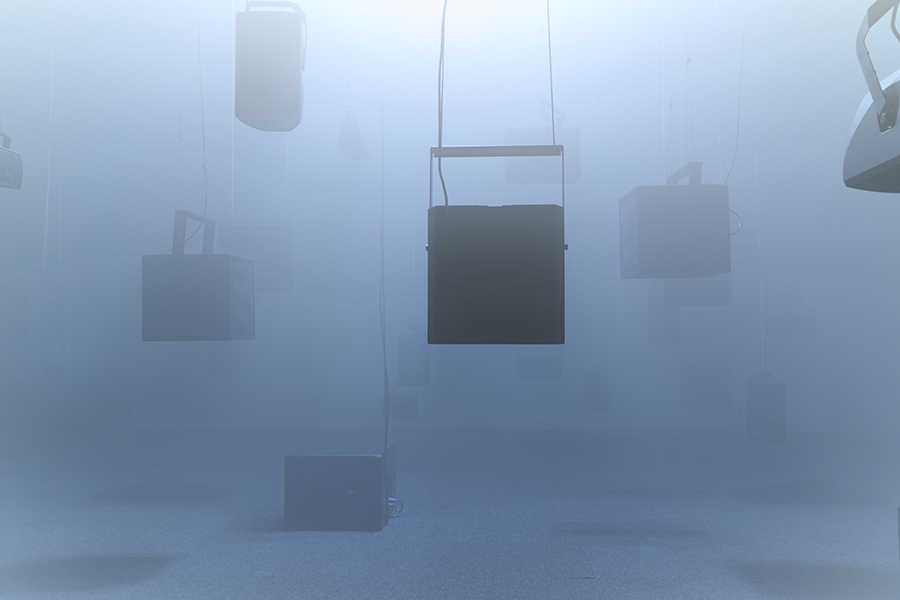
“A Predatory Chord is very much about setting up a framework for things to occur, more than it is a composition – where this thing happens here, that thing happens then. None of that is really in my control. It’s very much about putting a very specific group of elements into a system and then just pressing go and allowing it to do what it does and be what the audience submits it to, whatever that effect is. Fundamentally, the work is doing what it naturally wants to do.”
Frost and I have a meaningful discussion about the energy in materials, the energy that is found in wood and other natural or naturally derived materials, like limestone, brick and metal – the materials Victoria Hall is made from. Frost draws on this as part of the living ecosystem of his installation – how the sound reacts with the space, the light and the materials and the energy of those materials used to build that space. It was highly interesting, to say the least, and this is what Frost refers to when he says “the work is doing what it naturally wants to do.” It’s a force that’s out of his control – it’s a natural force that is taking on a life of its own that he has set the stage for in A Predatory Chord.
I can’t help but bring my Hindu roots into the conversation – Vastu Shastra is an ancient Hindu wisdom that ties in architecture with spatial design, placement of materials and harmonising physical structures with natural energies. It speaks of the energies that natural materials embody and that’s what I see and feel when I experience A Predatory Chord. Here, the force of sound does indeed become a living organism in the way it vertebrates around Victoria Hall amongst the elements it’s presented with – physical space, light, darkness, materials and the energy of those materials, and, of course the person or persons in that space. At no one time is that sound the same, it’s always different, ever evolving and does indeed take on a life of its own.
“It’s an attempt of conjuring the essence of a natural phenomenon into an artificial space. But where that starts to get really interesting, specifically here, is that these works that I make, ultimately has to exist in a place. When the thing that I’ve made, ultimately rubs up against the place that it exists in, that conversation always changes,” he explains.
So, what next for Ben Frost? In terms of career, the artist says he’s focused more on creating time-based immersive artworks, much like A Predatory Chord. His orientation has shifted away from music and more into physical manifestations and ideas. “A big part of that is re-contextualising this speaker technology, maybe reanimating these objects that are literally, by design, supposed to be invisible. You’re not supposed to look at them. They have this innate invisibility so I’m trying to bring that into a space where you are confronted with them, those boxes. You’re confronted with the actual source of sound. It’s not just sound – where is the sound, where is the sound coming from? It’s there. It’s a tangible experience. There’s a materiality in that. These speakers are made of a number of different elements – the speaker cones are fabricated from paper, there’s a lot of copper involved, cadmium – there’s all kinds of different earth materials which have a massive impact.”
Frost’s vision for the future is expansive, yet grounded. Beyond creating and in terms of life-goals, the artist says one thing close to his heart would be to restore parts of Australia that have been taken away from nature and given over to agriculture, seeing it as a responsibility as much as a privilege. It doesn’t come from nostalgia, according to him, but more from a deep sense of responsibility he bares, coming from an ancestry that is responsible for much of the destruction of Australia’s natural habitats. “If there was any way, some way, that I could make that occur, I think that would be my ultimate goal, is to take part in the reformation.” It’s an acknowledgment that art does not exist in isolation but in conversation with the world – its past, its present and the possibilities it holds. By choosing to engage more deeply with this land and its histories, Frost seeks not only personal reconciliation but also a way to contribute to something enduring, something that, in its own quiet way, nurtures understanding, reflection and perhaps healing.
The artist says that another dream goal would be to ultimately spend half of his time here in Australia. Frost speaks of the dark history of Australia’s colonisation and the pain and discomfort he endured coming from that which caused much destruction and pain. “There’s a kind of reckoning that needs to occur on my side, spiritually and creatively. I think if I’m honest about it, and I want to be, I think that it’s clear to me now that part of the reason I left Australia when I did was to run away. It was a search, it was exploratory, but I think an element of it was also about escaping an idea of who I was, where I’d grown up.”
Frost left Australia as a young twenty-something man and found a home far away – far, far away in Reykjavic, Iceland and he says he feels there’s place now, for him to spend more time in Australia to confront the very thing he ran away from.“Wanting to get away from it and be someone else. The fact is, with time, and twenty-plus years now on top of that, I am very aware of just how deeply engrained this place is in my person. To come back to this now and putting my focus now on the rupture points of that discomfort that I felt here – pressing on that wound feels like the right time to do that and I think I have better tools for that now.”
The artist acknowledges there’s much to Australia yet to be discovered. “There’s so much stuff about this place that I don’t know – we’ve been cheated and I feel that my generation, we were deeply cheated of the understanding of the place we grew up in, about the uncomfortable truths about the history of this place and how we, meaning white people, ended up here and everything that existed beforehand being swept aside as this blip on the radar that somehow required our intervention. I think we all are very much aware now, and thankfully, that is not the case anymore.”
In returning to Australia, Frost is not simply coming home – he is stepping into the tension between past and present, creation and accountability. His work, his presence and his intentions all carry a reckoning with history, identity and the natural world. A Predatory Chord is more than sound; it is a meditation on responsibility, a call to listen and a space where confronting darkness becomes an act of care. As he immerses himself in this land again, Frost reminds us that art can be both mirror and remedy, challenging us to face uncomfortable truths while imagining the possibilities of restoration, connection and hope.
A Predatory Chord can be experienced at Fremantle Biennale’s SANCTUARY 25 13-30 November, Thursday to Sunday from 11am-8pm. Bookings are essential.
This editorial was created for Fremantle Biennale by Skripture